

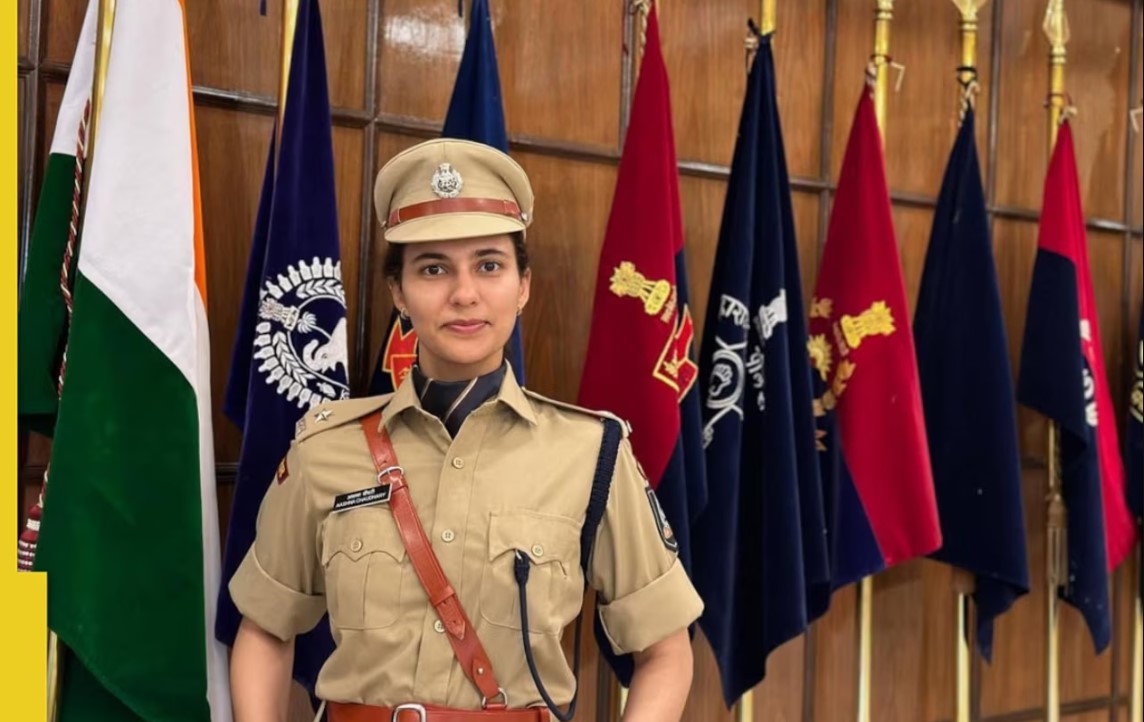
The journey of becoming a civil servant in India requires patience, discipline, consistent preparation and the ability to overcome repeated challenges. Every year, millions of candidates prepare for the Union Public Service Commission (UPSC) Civil Services Examination, hoping to secure a respected position in the country’s administrative or police services. However, only a limited number achieve this goal. Among the inspiring personalities who have attracted attention through their determination and academic achievements is Aashna Chaudhary, an Indian Police Service (IPS) officer whose success story demonstrates the importance of perseverance and self-confidence.
Coming from Pilkhuwa in Uttar Pradesh, she gradually developed an interest in education and public service. Her academic journey included studying at reputed institutions and pursuing higher education in subjects that expanded her understanding of society, international affairs and public administration. Her determination eventually helped her overcome unsuccessful attempts at the UPSC examination and achieve an impressive All India Rank of 116 in the Civil Services Examination 2022. Her achievement became particularly interesting for aspirants because she demonstrated that setbacks do not necessarily determine the outcome of a person’s career.
Today, her professional journey attracts attention from students, competitive examination candidates and people interested in the lives of young civil servants. Her story is not simply about securing a rank in a difficult examination; it also highlights the importance of learning from mistakes, improving preparation strategies and remaining committed to long-term goals.
Who Is Aashna Chaudhary?
Aashna Chaudhary is an Indian Police Service officer belonging to the 2023 batch and the Uttar Pradesh cadre. She became widely recognised after securing the 116th position in the UPSC Civil Services Examination 2022. Her achievement placed her among the successful candidates selected for India’s prestigious civil services.
She comes from Pilkhuwa, a town in Hapur district of Uttar Pradesh. Her educational background and interest in academics played an important role in shaping her career ambitions. Rather than limiting herself to a single academic discipline, she explored subjects that helped her understand literature, society and international relations. This educational foundation also contributed to developing analytical thinking and communication skills, which are valuable qualities for civil service aspirants.
Her professional identity is particularly associated with policing and public responsibility. The Indian Police Service offers opportunities to work in law enforcement, crime prevention, public safety and administrative coordination. These responsibilities require strong decision-making abilities, patience and an understanding of public concerns.
Early Life and Family Background
The early life of Aashna Chaudhary is connected with Pilkhuwa in Uttar Pradesh. She grew up in an environment where education and academic development received importance. Her father, Ajeet Singh, has been mentioned in media reports as a college professor. Her family background helped provide an educational atmosphere that encouraged learning and personal development.
Growing up in an academically supportive environment can influence how young people approach their ambitions. However, achieving success in a competitive examination requires individual commitment beyond family encouragement. Candidates must develop independent thinking, manage their time and remain focused even when results are disappointing.
Her educational journey also involved studying in different cities. Such experiences can expose students to different environments, teaching methods and social perspectives. These opportunities help develop adaptability, confidence and communication skills, which are useful throughout professional life.
Although public interest in her biography has increased, not every detail about her childhood and family life is officially documented. Therefore, it is important to distinguish publicly available information from assumptions when discussing her personal background.
Educational Qualifications and Academic Journey
Education has been an important part of her journey towards the civil services. She completed her schooling at different institutions before pursuing higher education in Delhi. Reports about her academic background mention St. Mary’s School in Udaipur and Delhi Public School, Ghaziabad.
She reportedly achieved 96.5 percent marks in her Class 12 examinations, demonstrating a strong academic foundation. Her performance during school reflected her interest in studies and ability to maintain academic consistency.
Graduation from Lady Shri Ram College
After completing school, she pursued a Bachelor of Arts degree with Honours in English Literature from Lady Shri Ram College for Women, Delhi University. The institution is known for its academic environment and emphasis on developing independent thinking.
Studying English literature involves analysing different forms of writing, understanding social themes and interpreting complex ideas. These abilities can be useful for students preparing for competitive examinations because UPSC preparation requires extensive reading, comprehension and the ability to express arguments clearly.
Postgraduate Studies at South Asian University
After graduation, she continued her academic development by pursuing a master’s degree in International Relations from South Asian University in New Delhi.
International Relations is a subject that explores relationships between countries, global political developments, international organisations, diplomacy and security issues. These topics are also relevant to the civil services examination, particularly its General Studies papers.
Her academic qualifications can be summarised below:
| Educational Stage | Institution or Qualification |
|---|---|
| Schooling | St. Mary’s School, Udaipur, and Delhi Public School, Ghaziabad |
| Graduation | BA Honours in English Literature |
| College | Lady Shri Ram College for Women |
| Postgraduation | Master’s in International Relations |
| University | South Asian University |
Her educational choices demonstrate how students from different academic backgrounds can prepare for the UPSC examination. A candidate does not necessarily need an engineering, medical or political science degree to pursue a career in the civil services.
UPSC Preparation Journey and Initial Challenges
The UPSC Civil Services Examination is among the most competitive examinations in India. It evaluates candidates through multiple stages, including Preliminary Examination, Main Examination and Personality Test. Success requires more than memorising information because candidates must develop analytical abilities, awareness of current affairs and effective writing skills.
Her preparation journey reportedly began around 2019. Like many other aspirants, she experienced difficulties during her initial attempts. She could not clear the Preliminary Examination in her first two attempts, which became an important learning experience.
Failing an examination can affect confidence, especially when candidates have invested considerable time and effort in preparation. However, the ability to evaluate mistakes and make necessary improvements often determines whether someone can progress towards their goal.
Instead of abandoning her ambition, she reconsidered her preparation strategy. Greater attention to revision, practice questions, mock examinations and answer-writing techniques helped her work on areas that needed improvement.
Preparing Without Depending on Coaching
One interesting aspect of her success story is the reported role of self-study in her preparation. Media accounts have highlighted that she achieved her UPSC goal without depending on regular coaching during her successful preparation phase.
Self-study does not mean preparing without guidance or resources. It involves taking responsibility for understanding the syllabus, selecting appropriate study materials, following current affairs and evaluating one’s own performance.
For example, an aspirant preparing independently can divide the syllabus into smaller topics, create weekly revision targets and practise previous years’ question papers. Regular mock tests can help identify weaknesses before the actual examination.
Her experience offers an important lesson: coaching may provide structure and guidance, but personal discipline, consistency and a clear understanding of the examination remain essential.
UPSC 2022 Result and All India Rank 116
The most significant milestone in her academic and professional journey came with the announcement of the UPSC Civil Services Examination 2022 results in 2023. After two unsuccessful attempts, she successfully cleared the examination in her third attempt and secured All India Rank 116.
According to the UPSC examination marks record, her final score was 992 marks. This included 827 marks in the written examination and 165 marks in the Personality Test.
Her result can be understood through the following details:
- Examination: UPSC Civil Services Examination 2022.
- All India Rank: 116.
- Written examination marks: 827.
- Personality Test marks: 165.
- Total marks: 992.
Securing a position within the top candidates is a major accomplishment because the examination attracts applicants from different educational and professional backgrounds. Her result demonstrated the value of continuing preparation even after facing disappointment.
Another important point is that achieving a particular rank does not automatically determine the service a candidate receives. Service allocation depends on factors such as rank, category, service preferences and available vacancies. In her case, she was allocated the Indian Police Service.
Why Did She Choose the Indian Police Service?
The Indian Police Service is one of India’s three All India Services. IPS officers are responsible for maintaining law and order, preventing crime, supervising police administration and supporting public safety.

A career in the police service involves responsibilities that extend far beyond routine law enforcement. Officers may work on public security arrangements, investigations, crime prevention, emergency management and coordination with different government departments.
Choosing this profession requires an interest in serving society while handling challenging situations. Police officers regularly interact with citizens from different backgrounds and must make decisions that can directly affect public welfare.
For young candidates, the IPS represents an opportunity to contribute to society through practical leadership and institutional responsibility. The profession also requires physical fitness, emotional stability, integrity and the ability to work under pressure.
Her selection for the service reflects the outcome of her performance in the UPSC examination and the subsequent service allocation process.
Professional Career and Current Posting
Following her selection, she entered the professional training and service system associated with the Indian Police Service. Newly recruited IPS officers undergo structured training to understand policing methods, legal procedures, leadership responsibilities and administrative operations.
The training period provides practical exposure to the challenges officers may face during their careers. It also helps them understand the importance of teamwork, discipline and public accountability.
According to available professional information updated in 2026, she is serving as an Assistant Superintendent of Police (ASP) in Mathura, Uttar Pradesh. The posting places her within the operational police administration of an important district known for its religious, cultural and historical significance.
Responsibilities of an Assistant Superintendent of Police
An Assistant Superintendent of Police holds an important position in district-level policing. The responsibilities associated with the role can include supervising police operations, monitoring law-and-order situations and coordinating with other officers.
The position requires officers to understand local concerns and respond appropriately to different situations. Public complaints, traffic management, crime prevention and security arrangements can form part of the broader policing environment.
An ASP must also maintain professional standards while ensuring that citizens receive appropriate assistance. Effective communication and transparent procedures are important for building public trust.
Personal Life and Marriage
Public interest in her biography has also increased because of her personal life. She married Abhinav Siwach, an Indian Administrative Service officer, in November 2025, according to published media reports.
He is associated with the 2023 batch of the Indian Administrative Service and belongs to the Haryana cadre. Their professional backgrounds connect them with two important branches of India’s civil services.
Both administrative and police officers work within the larger framework of public administration, although their responsibilities and institutional roles differ. Their careers require dedication, professional discipline and an understanding of public service.
While personal milestones often attract public attention, it is equally important to respect the privacy of civil servants. Their professional achievements and publicly confirmed information provide a meaningful foundation for understanding their journeys without relying on unnecessary speculation.
Aashna Chaudhary as an Inspiration for UPSC Aspirants
The journey of Aashna Chaudhary offers several lessons for students preparing for highly competitive examinations. One of the most important lessons is that failure should be treated as feedback rather than a permanent limitation.
Many UPSC aspirants struggle during their first or second attempts. Some find it difficult to complete the syllabus, while others face challenges with answer writing, time management or examination pressure. Her experience demonstrates that a candidate can reconsider their strategy and continue working towards the same objective.

Another lesson concerns the importance of academic flexibility. Her background in English literature and International Relations shows that candidates from humanities disciplines can also achieve success in the civil services. What matters is how effectively they understand the syllabus and apply their knowledge.
Important Lessons from Her Journey
Aspirants can draw several practical lessons from her experience:
- Learn from setbacks: Evaluate mistakes instead of repeating the same preparation strategy.
- Maintain consistency: Regular study and revision are more useful than occasional intensive preparation.
- Develop writing skills: Clear and structured answers are important for the Mains examination.
- Believe in self-study: Independent preparation can work when supported by discipline and suitable resources.
These lessons are relevant not only to UPSC candidates but also to students preparing for other demanding academic and professional goals.
The Importance of Discipline and Self-Confidence
Preparing for a competitive examination requires a long-term approach. Students often become distracted by the achievements of other candidates or feel discouraged when their preparation does not produce immediate results.
A more effective approach involves creating realistic daily targets and monitoring progress regularly. For example, completing two syllabus topics, reading current affairs and practising answer writing can create a manageable daily routine.
Self-confidence also plays an important role. It does not mean believing that success will come without effort. Instead, it means trusting the preparation process while remaining willing to identify and correct weaknesses.
Her journey highlights the importance of combining determination with practical improvements. Repeated attempts become meaningful when candidates use the experience to understand the examination more effectively.
Conclusion
The professional journey of Aashna Chaudhary demonstrates how determination, academic development and the willingness to learn from failure can contribute to success in one of India’s most competitive examinations. From her educational background in Uttar Pradesh and Delhi to her graduation in English literature and postgraduate studies in International Relations, her journey reflects a commitment to continuous learning.
Her achievement of All India Rank 116 in the UPSC Civil Services Examination 2022 and subsequent selection for the Indian Police Service marked an important turning point in her career. Her professional responsibilities as an ASP in Mathura also represent the beginning of a career focused on law enforcement, public safety and institutional service.
For aspiring civil servants, her story provides a practical reminder that unsuccessful attempts do not have to end a dream. With proper planning, consistent revision, self-analysis and patience, candidates can improve their performance and move closer to their objectives. Ultimately, her journey is an example of how persistence and a willingness to improve can turn long-standing ambitions into meaningful professional achievements.