

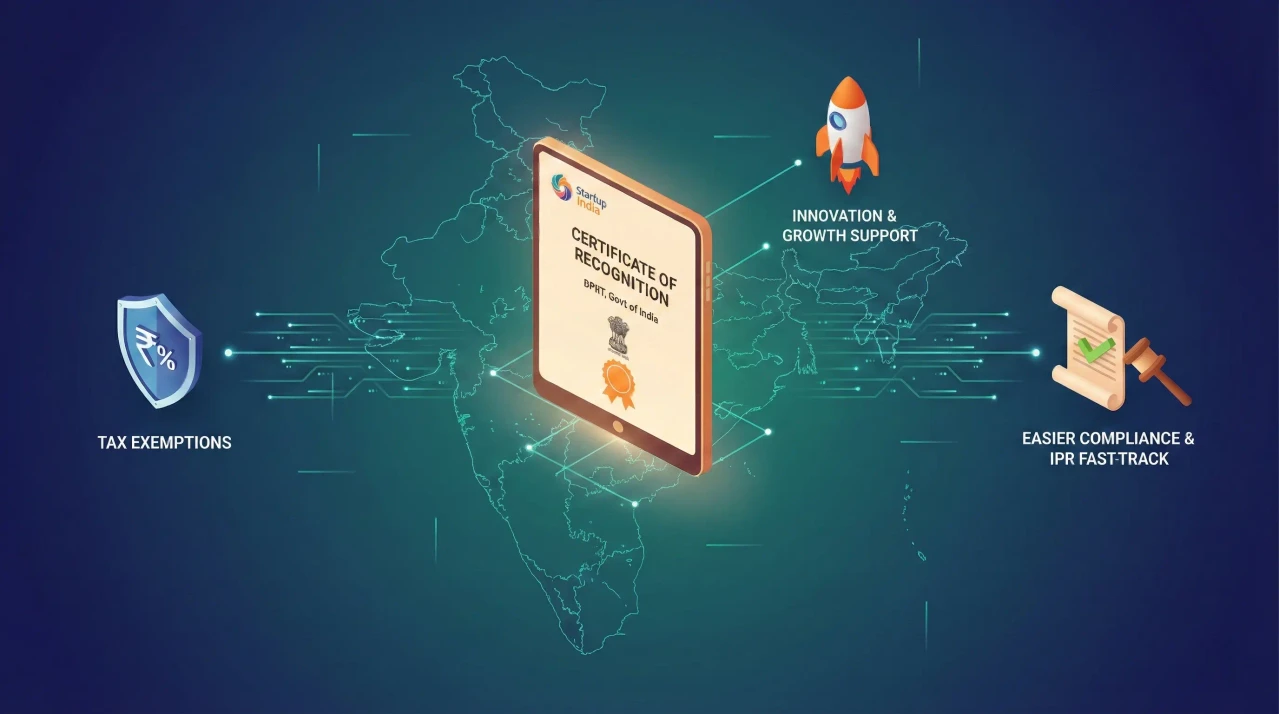
Starting a business in India can be an exciting opportunity, but turning an idea into a sustainable company requires careful planning, financial discipline, and an understanding of government regulations. Entrepreneurs often need support with business registration, funding opportunities, intellectual property protection, taxation, and compliance. To encourage innovation and entrepreneurship, the Indian government introduced the Startup India initiative, which aims to create a supportive environment for new businesses and help them grow into successful enterprises. One important part of this initiative is recognition by the Department for Promotion of Industry and Internal Trade (DPIIT).
A startup that meets the applicable requirements can apply for a startup india certificate through the official recognition process. This recognition can help an eligible business access certain government-supported benefits, participate in selected startup programs, and demonstrate its status as an innovation-focused enterprise. However, receiving recognition does not automatically provide every tax exemption, grant, loan, or investment opportunity. Each benefit has its own eligibility conditions and application requirements. Understanding the process before applying helps founders prepare accurate documents, avoid common mistakes, and make informed decisions about their businesses.
For entrepreneurs launching a technology company, manufacturing venture, service business, or innovative digital platform, DPIIT recognition can be a useful step in the early stages of business development. Knowing who qualifies, which documents are needed, how the application works, and what happens after approval makes the process easier to manage.
What Is a Startup India Certificate?
A Startup India certificate generally refers to the recognition granted by DPIIT to an eligible business under the Startup India initiative. It identifies a qualifying entity as a recognized startup for the purposes covered by the relevant government framework. This recognition is different from ordinary company registration, GST registration, or obtaining a Permanent Account Number (PAN). Those registrations serve separate legal and tax purposes, while DPIIT recognition focuses on whether a business satisfies the prescribed startup criteria.
For example, consider a small company developing software that helps local retailers manage inventory and predict customer demand. If the company meets the applicable age, turnover, entity, and innovation-related requirements, it may be eligible to seek recognition. The certificate can strengthen its profile when exploring suitable startup programs or preparing applications for eligible benefits. Nevertheless, recognition should not be interpreted as a government guarantee of commercial success, funding, or profitability. The company must still build a viable product, find customers, manage expenses, and comply with all laws relevant to its activities.
Why Is DPIIT Recognition Important for Entrepreneurs?
DPIIT recognition can be valuable because early-stage businesses often face challenges that established companies are better equipped to handle. Founders may need to demonstrate credibility to potential partners, understand intellectual property protections, or identify government programs designed for innovative businesses. Recognition can provide a formal starting point for exploring some of these opportunities. It may also help entrepreneurs understand the broader support ecosystem available to startups in India.
Another important advantage is that recognition can make an eligible business more prepared to apply for specific schemes or benefits. For instance, a startup developing a new agricultural monitoring device may explore suitable incubation programs, while a software company might investigate intellectual property support or qualifying procurement opportunities. The actual benefits available depend on the company’s circumstances and the requirements of each program. Entrepreneurs should therefore evaluate recognition as one part of a broader business strategy rather than treating it as a substitute for proper financial management, market research, or regulatory compliance.
Eligibility Criteria for Startup India Recognition in 2026
Before applying, founders should confirm that their business falls within the eligibility framework currently applicable to DPIIT recognition. The government revised the framework in February 2026, increasing the turnover limit for regular startups and introducing expanded eligibility for deep-tech businesses. These changes are important because older articles may still mention outdated financial thresholds. Eligibility depends on the legal structure, the date of incorporation or registration, turnover, and the nature and objectives of the business.
Under the revised framework, a regular startup generally must have been incorporated or registered in India as an eligible entity, have existed for no more than 10 years, and have turnover not exceeding ₹200 crore in any financial year since incorporation. Recognised deep-tech startups may qualify under an extended period of up to 20 years and a turnover limit of ₹300 crore, subject to the applicable requirements. The business must also work towards innovation, development, or improvement of products, processes, or services, or operate a scalable model with strong potential for employment generation or wealth creation. A business created by splitting up or reconstructing an existing business does not qualify merely because it has a new name.
Which Business Structures Can Apply?
Eligible structures include private limited companies, registered partnership firms, limited liability partnerships (LLPs), and qualifying cooperative societies. Sole proprietorships do not qualify for DPIIT recognition under the standard entity categories. Therefore, an individual running a small online store under a personal business name may need to consider an appropriate legal structure before applying.
The right structure depends on factors such as the number of founders, funding plans, liability, compliance costs, and long-term business goals. For example, a technology startup planning to raise equity investment may prefer a private limited company, whereas a professional venture with different operational requirements may consider an LLP. Entrepreneurs should choose a structure for sound business reasons rather than registering an entity solely to obtain recognition.
Documents Required for the Application
Preparing accurate documents in advance can make the application process smoother. The objective is to establish that the business legally exists and to explain what it does, how it operates, and why it meets the recognition criteria. The exact information requested may vary depending on the entity type and whether the applicant seeks recognition under the regular or deep-tech framework.
In most cases, applicants should prepare their incorporation or registration certificate, PAN details, business description, and information about directors, partners, or authorised representatives. The application may also require supporting material demonstrating the business model, innovation, product development, or scalability. Founders should ensure that the information entered in the form matches the official business records. Inconsistent names, incorrect registration details, incomplete explanations, or unsupported claims can create avoidable delays.
Commonly useful documents and information include:
-
Certificate of incorporation or registration for the eligible entity.
-
PAN details and information about directors, partners, or authorised signatories.
-
A clear description of the business, its products or services, and its target customers.
-
Supporting evidence such as a pitch deck, prototype details, product presentation, or proof of concept, where relevant.
A startup does not necessarily need to have a fully commercialised product before seeking recognition. However, the founder should be able to explain the business idea convincingly and demonstrate how the venture fits the applicable criteria. Deep-tech applicants should pay particular attention to any additional evidence requested in the application.
How to Apply for a Startup India Certificate
The recognition process is online, and eligible businesses can submit their applications through the National Single Window System. Applicants should use their own business information and authorised contact details. It is important to distinguish DPIIT recognition from registering a company: the business must first have an eligible legal identity before applying for recognition.
To apply for a startup india certificate, founders should create or access their account on the National Single Window System, add the relevant startup recognition application under central approvals, and complete the form carefully. They should provide the requested business information, upload the supporting documents, review the declaration, and submit the application. The application should accurately describe the product, service, innovation, or scalable business model instead of relying on generic statements that could apply to any company.
Once submitted, the application may be reviewed for completeness and eligibility. Founders should monitor their application status and respond appropriately if further information is requested. Processing time can vary, so applicants should avoid relying on a guaranteed approval date. They should also check the current instructions displayed in the application system because document requirements and procedures can change.
How to Improve the Quality of Your Application
The strongest applications explain the business in practical terms. Instead of writing that a company uses technology to improve efficiency, describe the actual problem it solves, the people who experience that problem, and how the proposed solution works differently from existing alternatives. A startup creating an affordable water-monitoring device, for example, could explain how its sensors help farmers identify irrigation needs and reduce unnecessary water use.
Founders should also avoid exaggerating their progress or claiming that a product is unique without explaining its distinguishing features. If the business is still developing a prototype, describe its current stage honestly. If it already has customers, pilot projects, or early sales, explain those developments accurately. Clear evidence and a consistent business description help reviewers understand the venture more effectively.
Benefits of Getting DPIIT Recognition
The benefits associated with recognition can help eligible startups reduce certain business barriers and explore growth opportunities. However, the availability of each benefit depends on the relevant rules, scheme conditions, and application procedures. A startup should identify which benefits are useful for its specific business rather than assuming that every recognised entity receives every incentive automatically.
1. Intellectual Property Rights Support
Innovation-driven businesses often need to protect their inventions, software-related innovations, designs, or brand identities. Eligible startups may be able to access intellectual property support, including assistance with patent applications and applicable fee concessions. These facilities can be particularly valuable for businesses developing new machinery, medical technologies, agricultural products, or other research-intensive solutions. Founders should check the specific eligibility requirements and applicable professional charges before planning their intellectual property budget.
2. Government Tender Opportunities
Government departments can be potential customers for startups offering suitable products and services. DPIIT recognition may help eligible businesses access certain public procurement relaxations, including applicable exemptions from prior experience, turnover requirements, or earnest money deposits. These relaxations are subject to the relevant tender conditions and do not remove quality standards, technical specifications, or the need to demonstrate the ability to deliver a contract.
3. Tax Benefits for Eligible Businesses
Tax benefits are among the most frequently discussed advantages of DPIIT recognition. However, obtaining recognition alone does not automatically grant an income tax holiday. Eligible businesses must satisfy the additional conditions for the relevant tax provision and complete the required approval process. Under Section 80-IAC, qualifying startups may receive a deduction for three consecutive financial years out of their first ten years, subject to the applicable law and eligibility criteria.
4. Easier Compliance and Startup Support
Recognised startups may also benefit from specified self-certification arrangements under applicable labour and environmental laws, along with access to selected government-supported programs, incubators, and entrepreneurship initiatives. These arrangements are intended to reduce certain administrative burdens and encourage business development. They should not be interpreted as a general exemption from all legal responsibilities.
Startup India Certificate vs. Other Business Registrations
Entrepreneurs sometimes confuse DPIIT recognition with other registrations required to operate a business. Understanding the differences helps founders avoid applying for the wrong document or assuming that one certificate replaces every other registration.
| Registration or document | Main purpose |
|---|---|
| Company or LLP registration | Establishes the legal business entity under the applicable law. |
| GST registration | Addresses goods and services tax obligations where registration is required. |
| Udyam registration | Provides MSME registration for eligible micro, small, and medium enterprises. |
| DPIIT recognition | Recognises an eligible startup under the Startup India framework. |
| Income tax exemption approval | Establishes eligibility for a particular tax benefit when its separate conditions are met. |
These registrations serve different purposes, and a business may need more than one depending on its activities. For example, an eligible private limited company could obtain DPIIT recognition while separately assessing whether GST registration, Udyam registration, or another approval is applicable. Founders should determine their legal and tax obligations based on their actual business operations.
Is the Startup India Certificate Free?
Yes, the government does not charge an application fee for DPIIT startup recognition. Eligible businesses can complete the official recognition process themselves without paying an intermediary to submit the application. This makes the scheme accessible to early-stage founders who may have limited funds available for administrative expenses.
However, businesses may still incur separate costs for incorporation, professional advice, accounting, legal documentation, or other registrations. These are not the same as a government fee for DPIIT recognition. Founders should be cautious about private agents claiming that a payment is compulsory for obtaining the recognition certificate. If professional assistance is needed, its service charges should be clearly distinguished from official government fees.
How to Download and Verify the Certificate
After approval, the startup can access its digital recognition certificate through the relevant government system. Founders should save a copy securely and keep their certificate details alongside their incorporation documents, PAN information, and other important business records. The digital certificate can be useful when applying for programs that specifically require evidence of DPIIT recognition.
If a bank, investor, incubator, or government department requests proof of recognition, the founder should provide the appropriate certificate and any additional documentation required by that organisation. The startup india certificate can also be verified through the government’s certificate validation facility. If the certificate cannot be located or its details appear incorrect, the founder should review the registered account and follow the applicable official process to resolve the issue.
It is also sensible to review recognition details after significant business changes. If the company changes its name or other registered information, the founder should check whether the recognition record needs updating and follow the prescribed procedure rather than assuming that changes to company records automatically update the certificate.
Common Mistakes to Avoid During Application
Although the recognition process is online, careless preparation can create unnecessary difficulties. Some applicants provide vague descriptions of their businesses, submit documents with inconsistent details, or confuse incorporation with DPIIT recognition. Others assume that every new business automatically qualifies, even when its legal structure or business model does not meet the prescribed criteria.
To reduce these risks, founders should check their eligibility against the latest applicable framework, prepare the necessary documents, and review every declaration before submission. They should also understand that recognition does not guarantee loans, grants, investment, tax exemptions, or government contracts. Each opportunity has separate conditions, and the business remains responsible for complying with applicable laws.
Conclusion
The startup india certificate is an important recognition document for eligible entrepreneurs seeking to build innovative and scalable businesses in India. It can help founders explore government-supported opportunities, certain intellectual property benefits, public procurement relaxations, and other startup-related programs. Its practical value depends on the nature of the business, its growth plans, and the specific benefits for which it qualifies. The best approach is to begin by selecting the appropriate legal structure, confirming eligibility under the current DPIIT framework, and preparing accurate supporting documents. Applicants should then complete the online process carefully, monitor the application status, and retain their digital certificate after approval. They should separately assess tax benefits and other incentives instead of assuming recognition automatically provides them.