

Getting formal recognition can be an important step for a new business in India. The startup India certificate is commonly associated with recognition under the Startup India initiative, which is designed to help eligible businesses access certain benefits, visibility, and support.
A startup may have an innovative product, a scalable service, or a new approach to solving a market problem. However, administrative requirements can become confusing when several registrations, tax matters, intellectual property options, and government schemes overlap. Startup recognition helps create a clearer official identity for an eligible business and can make it easier to explore relevant support.
What Is Startup Recognition and Why Does It Matter?
The startup India certificate refers to the recognition issued to an eligible entity under the Startup India framework. It is not the same as incorporation or business registration. A company, limited liability partnership, or eligible partnership may first need to be legally established before applying for recognition, subject to the applicable rules.
The distinction is important. Incorporation creates the legal business entity, while startup recognition confirms that the entity qualifies under the prescribed startup framework. Founders should therefore think of recognition as an additional status rather than a replacement for basic business registration.
Depending on eligibility and current rules, recognised startups may benefit from certain regulatory, tax, intellectual property, procurement, or compliance-related provisions. Benefits are not automatic in every case, so founders should verify the conditions attached to each facility.
Who Can Apply for Startup India Recognition?
Eligibility is based on the nature and age of the business, its structure, and other conditions prescribed under the applicable Startup India rules. The framework has evolved over time, so entrepreneurs should check the current requirements before submitting an application.
Generally, the business should be working toward innovation, development, improvement of products or services, or a model with potential for employment or wealth creation. Recognition is intended for genuine startups rather than businesses created simply to obtain a particular certificate.
Common entity structures that may be considered include:
- Private limited companies
- Limited liability partnerships
- Eligible partnership firms
The business should also satisfy relevant conditions concerning incorporation date, turnover, restructuring, and innovation or scalability. Because these conditions can change through policy updates, relying on an old checklist can create unnecessary problems.
Documents and Information Founders Should Prepare
A smooth application usually begins with accurate business information. Founders should keep incorporation or registration documents, entity details, promoter information, and a clear explanation of the business model ready.
Depending on the entity and application circumstances, founders may need information relating to:
| Area | What to Prepare | Why It Matters |
|---|---|---|
| Entity details | Incorporation or registration information | Establishes the legal identity |
| Business model | Product, service, target customers | Explains commercial activity |
| Innovation | Unique process, technology, or improvement | Supports the recognition rationale |
| Founders | Promoter and authorised representative details | Establishes applicant information |
| Supporting records | Relevant declarations or documents | Helps meet application requirements |
| Intellectual property | Patent, trademark, or related details if applicable | Can support the innovation explanation |
Accuracy matters more than volume. Submitting unnecessary documents or inconsistent information can make the application harder to review.
How the Application Process Generally Works
The process begins with creating or accessing the relevant government startup platform and providing the requested entity information. Applicants then complete the recognition application, describe their business, and provide declarations or supporting information required under the current process.
After submission, the application may be reviewed against the applicable eligibility criteria. If additional clarification or correction is required, the applicant should respond carefully and keep all business records consistent.
Once recognition is granted, the startup can use the recognition details when exploring eligible schemes and facilities. However, founders should remember that recognition itself does not guarantee approval for every benefit. Individual schemes can have separate eligibility requirements and application procedures.
Startup India Certificate vs Business Registration
One of the most common misunderstandings is assuming that the startup India certificate replaces company incorporation. It does not.
Business incorporation or registration establishes the legal entity. Depending on the structure, the business may also need tax registrations, licences, local permissions, employment-related registrations, or sector-specific approvals.
Startup recognition serves a different purpose. It identifies an eligible business within the government’s startup ecosystem and may provide access to certain benefits subject to conditions.
For example, imagine a technology company incorporated as a private limited entity. Its incorporation allows it to operate as a legal company, while startup recognition can separately establish its eligibility under the Startup India framework. The two processes complement rather than replace one another.
Benefits That Recognised Startups May Explore
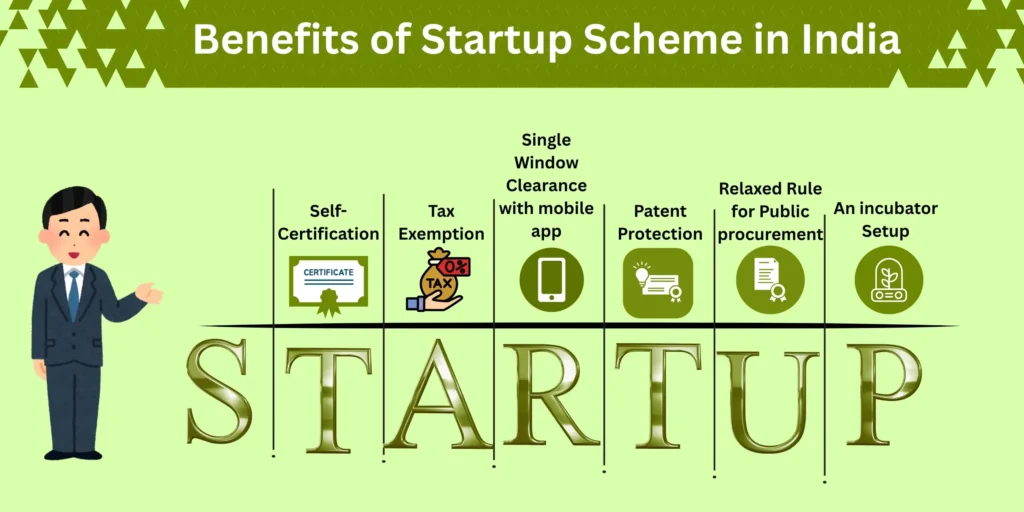
The value of recognition depends on the startup’s circumstances. Eligible businesses may be able to explore benefits connected with intellectual property support, public procurement, regulatory relaxation, tax provisions, or government-backed programs.
 Some founders also find recognition useful when presenting their business to ecosystem stakeholders. It can demonstrate that the entity has been formally recognised under the relevant startup framework, although it should not be presented as a guarantee of funding, profitability, or government approval.
Potential areas to investigate include:
- Intellectual property facilitation and support
- Certain procurement-related opportunities
- Eligible tax incentives where separate conditions are satisfied
- Government and incubation programs
- Startup ecosystem resources and networking opportunities
Each benefit should be checked independently. Tax incentives, for example, can have specific conditions that differ from the basic requirements for startup recognition.
Common Mistakes That Can Delay the Process
Many application problems come from avoidable inconsistencies rather than complicated legal issues. A company may describe itself one way in its incorporation records and use a substantially different description in its startup application. Such differences can create questions about the actual business activity.
Another mistake is treating the certificate as proof that every startup benefit has already been approved. Recognition and benefit eligibility are separate matters.
Founders should also avoid copying generic descriptions from other businesses. A precise explanation of the company’s product, customers, technology, and market opportunity is more useful than impressive but vague language.
Finally, keep company records updated. Changes in directors, ownership, registered details, business activity, or other material information may require appropriate updates under the applicable rules.
How to Make Your Application More Effective
The strongest application is usually straightforward, consistent, and evidence-based. Start by reviewing the current eligibility criteria and then map your business information against each requirement.
Explain the innovation in practical terms. If your startup improves an existing process, explain what was inefficient before and how your solution changes it. If you have developed proprietary technology, describe its role without making unsupported claims.
For founders unfamiliar with regulatory filings, professional advice can be useful, particularly when the business has complex ownership, restructuring history, intellectual property, or tax considerations.
What Happens After You Receive Recognition?
Receiving the startup India certificate should be viewed as the beginning of a broader compliance and growth journey rather than the final step. Founders should record the recognition details and understand where they can legitimately be used.
The next stage may involve exploring incubation, intellectual property protection, government procurement, funding opportunities, or other programs relevant to the business. Before applying for any benefit, read its individual conditions carefully.
A recognised startup must also continue meeting its ordinary legal and regulatory obligations. Recognition does not remove the need for accurate accounting, tax compliance, corporate filings, employment requirements, or sector-specific permissions.
Keeping these responsibilities organised can prevent a promising startup from developing avoidable compliance issues as it grows.
Conclusion
The startup India certificate can be a useful recognition for eligible businesses seeking to participate in India’s growing startup ecosystem. Its main value lies in establishing recognised startup status and opening the door to certain facilities that may be available under applicable government programs.
However, founders should not confuse recognition with incorporation, funding approval, or automatic access to every startup benefit. The best approach is to verify current eligibility requirements, prepare accurate business information, maintain consistent records, and assess each benefit separately.
For a new entrepreneur, the process becomes much easier when the business structure, innovation story, documentation, and compliance records are organised from the beginning. With that foundation in place, startup recognition can become one practical part of a larger strategy for building and scaling a sustainable business in India.