

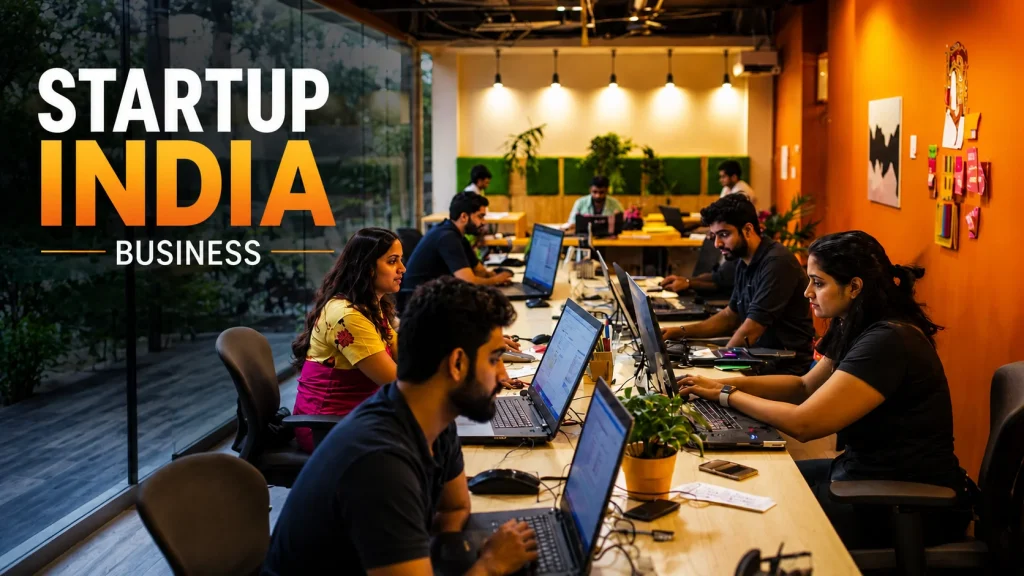
India has become an important destination for entrepreneurship, innovation, and technology-driven business development. From small businesses solving local problems to technology companies developing solutions for international markets, entrepreneurs are contributing to employment, investment, and economic growth. Affordable digital tools, expanding internet access, online payment systems, and changing consumer expectations have created opportunities for people who want to turn their ideas into sustainable businesses. However, starting a business still involves challenges such as raising capital, understanding legal requirements, building customer trust, and competing with established companies.
Startup India is a government initiative designed to encourage entrepreneurship and create a supportive environment for innovative businesses. It aims to help eligible startups navigate important stages of development through recognition, information about government support, access to certain funding programmes, and opportunities to connect with the wider business ecosystem. Rather than focusing only on launching new companies, the initiative also supports the broader objective of making India a place where entrepreneurs can develop practical solutions, create employment, and build scalable enterprises.
Understanding how this initiative works is useful for aspiring founders, existing business owners, students with entrepreneurial ambitions, and professionals considering a move into business. The available benefits depend on eligibility, applicable rules, and the specific programme involved. Entrepreneurs who understand these conditions can make better decisions, prepare stronger applications, and avoid assuming that government recognition automatically guarantees funding or tax exemptions.
What Is Startup India?
Startup India is an initiative launched by the Government of India in January 2016 to promote innovation, entrepreneurship, and the growth of new businesses. It was introduced to make the startup environment more supportive by addressing some of the administrative, financial, and operational difficulties that entrepreneurs commonly face. The initiative brings together several forms of assistance, including startup recognition, guidance on compliance, intellectual property support, and connections to funding and incubation opportunities.
An important feature of the initiative is its emphasis on innovation and the development of businesses with the potential to grow. A startup may introduce a new product, improve an existing service, develop a more efficient business process, or use technology to solve a problem in a particular industry. Examples include agricultural technology platforms that help farmers access markets, healthcare businesses that improve access to consultations, and software companies that simplify operations for small enterprises. The objective is not simply to increase the number of registered companies but to encourage ventures that can generate lasting economic and social value.
The initiative has also helped make entrepreneurship more visible as a career option. Earlier, many aspiring business owners believed that launching a company required substantial personal wealth or access to established business networks. Although capital and professional connections remain important, the development of incubators, digital business services, startup communities, and public support programmes has created additional pathways for founders to test ideas and develop their businesses.
How Startup India Works for Entrepreneurs
The initiative operates through a combination of recognition mechanisms, policy support, and programmes that may be delivered through different government departments, financial institutions, incubators, and partner organisations. Entrepreneurs can explore the opportunities relevant to their business stage, from validating an initial concept to developing a product, hiring employees, and expanding into new markets. The precise support available depends on the scheme, the startup’s eligibility, and the terms in force when an application is submitted.
Startup recognition is an important starting point for eligible businesses seeking access to benefits specifically linked to recognised startups. Founders generally need to establish that their business satisfies the applicable definition, organisational requirements, age limits, and turnover conditions. They may also need to explain the innovative nature of their product, service, process, or business model, or demonstrate its potential for employment generation or wealth creation. Recognition is not the same as incorporation: registering a company or another eligible legal entity and obtaining startup recognition are separate steps.
Entrepreneurs should also understand that the initiative is not a single fund that automatically provides money to every applicant. Different programmes have different application processes and selection criteria. Some provide access to incubators or mentors, while others support investment through eligible intermediaries, offer intellectual property assistance, or provide benefits subject to separate approvals. A founder who identifies the correct programme early can save time and focus on opportunities that match the business’s actual needs.
Key Benefits of Startup India
One of the major advantages of Startup India is that it provides a structured route for eligible businesses to explore support that might otherwise be difficult to identify. Entrepreneurs can learn about relevant government programmes, intellectual property assistance, incubation facilities, and funding opportunities without treating every business challenge as an entirely separate problem. This is particularly valuable for first-time founders who may have a promising idea but limited experience with company administration, investor discussions, or formal business planning.
Another important benefit is the possibility of accessing specific regulatory and financial incentives. Eligible startups may qualify for certain tax benefits, simplified compliance arrangements, or intellectual property-related support, subject to the relevant conditions and approvals. These benefits can reduce some administrative pressure and allow founders to concentrate more resources on product development, customer acquisition, and business improvement. However, each benefit has its own requirements, and recognition alone does not mean that every incentive becomes available automatically.
The initiative can also help entrepreneurs connect with the wider startup ecosystem. Incubators, accelerators, mentors, investors, industry experts, and fellow founders can provide valuable feedback during different stages of business development. A founder developing a new agricultural device, for example, may need technical testing, manufacturing advice, and access to farmers before the product becomes commercially viable. Support from the right ecosystem partners can help identify weaknesses early and improve the chances of building a business that customers are willing to pay for.
Startup India Eligibility Criteria
Eligibility is one of the most important factors to understand before applying for recognition. Under the general framework, a qualifying startup must meet the prescribed requirements concerning its legal structure, incorporation date, turnover, and business activities. The recognised entity must generally be established as a private limited company, a registered partnership firm, or a limited liability partnership. Sole proprietorships do not qualify for recognition under the standard framework simply because they operate as new businesses.
The general eligibility framework also requires the entity to remain within the prescribed age and turnover limits and not to have been formed by splitting up or reconstructing an existing business. For most eligible entities, the ordinary age limit is up to ten years from incorporation or registration, while the prescribed turnover ceiling is ₹100 crore in any financial year since incorporation or registration. Certain sector-specific provisions and special categories may have different conditions, so applicants should verify the rules applicable to their circumstances.
Innovation and growth potential are also important considerations. A business does not necessarily need to invent a completely new technology, but it should be able to demonstrate meaningful improvement, innovation, scalability, employment potential, or wealth creation in accordance with the applicable recognition criteria. A business that simply resells existing products without a qualifying innovative or scalable approach may not meet the relevant requirements.
Documents and Information to Prepare
Before starting an application, founders should organise the essential business information and ensure that the details match official records. The exact requirements can change, but the following items are commonly useful:
-
Certificate of incorporation or registration for the eligible business entity.
-
Basic business information, including the date of establishment and relevant identification details.
-
A clear explanation of the product, service, innovation, or business model.
-
Supporting information about the business’s potential for growth, employment generation, or wealth creation.
Keeping these records accurate can make the application process easier. Founders should avoid exaggerated claims about innovation, revenue, or future performance. A clear explanation supported by practical evidence is generally more useful than complicated business language.
How to Apply for Startup India Recognition
The application process begins with establishing an eligible legal business entity. Founders who have not yet registered their venture should first evaluate the appropriate structure, considering ownership, liability, taxation, compliance obligations, and future investment plans. A private limited company may suit a venture planning to raise equity investment, while another eligible structure may be appropriate for a business with different objectives. Professional advice can be helpful when the financial and legal implications are significant.
Once the entity is registered, the applicant can use the official government recognition process to submit the required information and supporting documents. The application generally involves providing incorporation details, describing the business, and explaining how it satisfies the applicable startup criteria. Founders should carefully review all declarations before submission and respond to requests for additional information if required. They should also distinguish startup recognition from other registrations, licences, tax applications, and sector-specific approvals that the business may need.
After receiving recognition, entrepreneurs should review each potential benefit separately. A recognised startup may still need to submit additional documents, meet particular conditions, or obtain approval from another authority before receiving a specific incentive. For instance, eligibility for a tax exemption may involve a separate application and additional statutory requirements. Recognition should therefore be treated as an important administrative milestone rather than a guarantee of immediate financial assistance.
Funding Opportunities and Financial Support
Access to finance is one of the most common challenges faced by startups. New ventures often need money for product development, market research, equipment, hiring, inventory, and customer acquisition before they generate enough revenue to cover their expenses. Startup India helps entrepreneurs discover funding-related programmes and support mechanisms, but the availability of finance depends on the programme, the business model, and the selection process.
Different funding options serve different purposes. Incubators may help early-stage founders refine their ideas, while angel investors and venture capital firms generally look for opportunities with appropriate growth potential and investment prospects. Banks and other lenders may assess repayment capacity, cash flow, collateral, or eligibility under specific lending arrangements. Government-supported funding programmes may operate through designated institutions or investment intermediaries rather than directly distributing money to every startup.
| Funding option | Typical purpose | Important consideration |
|---|---|---|
| Incubation support | Mentoring, workspace, and early-stage development | Availability varies by incubator |
| Angel investment | Early-stage capital and business guidance | Usually involves giving up equity |
| Venture capital | Financing expansion and high-growth ventures | Investors expect significant growth potential |
| Bank or institutional loans | Working capital, equipment, or expansion | Repayment obligations apply |
| Government-supported programmes | Eligible business development or investment support | Separate scheme conditions and selection apply |
Entrepreneurs should calculate how much funding they genuinely need before approaching investors or lenders. A startup that requires ₹10 lakh to test a product and establish initial sales may need a different funding strategy from a technology company seeking several crores to expand internationally. A realistic budget, credible revenue assumptions, evidence of customer demand, and a clear plan for using the money can make funding discussions more productive.
Tax Benefits and Intellectual Property Protection
Tax incentives can be valuable for startups that meet the relevant statutory conditions. Certain eligible businesses may apply for a profit-linked income tax deduction under Section 80-IAC of the Income-tax Act, subject to the applicable eligibility rules, approval requirements, and other restrictions. This benefit is not automatic for every recognised startup, and entrepreneurs should verify the current tax legislation and the specific conditions that apply to their incorporation date and business activities. Tax rules can change, so professional advice is useful before making financial decisions based on a potential exemption.
Intellectual property protection is another important consideration for innovative businesses. A startup may develop a distinctive brand, a software product, an industrial design, a technical invention, or original creative material that contributes to its competitive advantage. Appropriate protection can help prevent unauthorised use and strengthen the business’s position when negotiating with customers, distributors, or investors. Eligible startups may also be able to access facilitation and fee concessions for certain intellectual property applications under applicable rules. Founders should identify which assets need protection and confirm the relevant eligibility conditions before filing.
Challenges Faced by Startups in India
Although the entrepreneurial environment offers considerable opportunities, building a successful company remains difficult. New businesses must identify a genuine customer problem, create a reliable solution, establish a pricing strategy, and convince people to purchase from an unfamiliar brand. Competition can be intense, particularly in crowded sectors such as online retail, food delivery, education technology, and digital services. Even a technically impressive product may struggle if customers do not see enough value in it or if the cost of acquiring customers exceeds the revenue it generates.
Other challenges include cash-flow management, regulatory compliance, recruitment, and the difficulty of expanding beyond an initial market. A founder might receive funding but still encounter problems if spending grows faster than sales. Similarly, rapid hiring without a clear operational plan can increase costs before the business has developed reliable revenue. Government programmes can provide useful support, but entrepreneurs must continue to make careful decisions, understand their customers, and measure business performance.
Founders can improve their chances of success by focusing on a few practical priorities:
-
Test the business idea with real potential customers before investing heavily.
-
Maintain accurate financial records and monitor cash flow regularly.
-
Build a product or service around a clearly defined customer need.
-
Seek qualified legal, tax, and financial advice when necessary.
These steps help entrepreneurs build a stronger foundation instead of depending entirely on external support or short-term market enthusiasm.
The Future of Entrepreneurship in India
India’s startup ecosystem has opportunities across technology, manufacturing, agriculture, healthcare, clean energy, financial services, education, and logistics. Digital infrastructure and widespread smartphone use have made it easier for businesses to reach customers, while improvements in payment systems and online distribution have created new ways to sell products and services. At the same time, artificial intelligence, automation, and data-driven tools are creating opportunities for companies that can solve practical problems responsibly.
The next stage of growth will depend not only on launching new companies but also on building sustainable businesses. Entrepreneurs will need to pay attention to product quality, data protection, cybersecurity, responsible technology use, customer service, and long-term profitability. Businesses that understand the needs of smaller cities, rural communities, and underserved customer groups may find opportunities that established companies have overlooked. Strong execution and a clear understanding of local markets will remain essential.
In this environment, Startup India can serve as a useful starting point for discovering relevant government support and understanding the formal requirements of entrepreneurship. However, the initiative works best when founders combine available support with practical business knowledge, customer research, responsible financial planning, and a willingness to improve their products over time.
Conclusion
Entrepreneurship can create opportunities for individuals while contributing to employment, innovation, and economic development. For aspiring founders, understanding Startup India is an important step toward identifying suitable recognition pathways, exploring funding options, learning about potential tax benefits, and discovering intellectual property support. The initiative can help eligible businesses navigate the startup ecosystem, but its benefits depend on the relevant rules, programme conditions, and individual applications. A successful business requires more than registration or government recognition. Founders must understand their customers, manage money carefully, develop useful products, and adapt to changing market conditions. They should also verify current eligibility requirements and avoid assuming that every government incentive applies to their venture.